


Enlightenment and 19th Century Origins of Hard Times
Published Friday, August 27, 2010
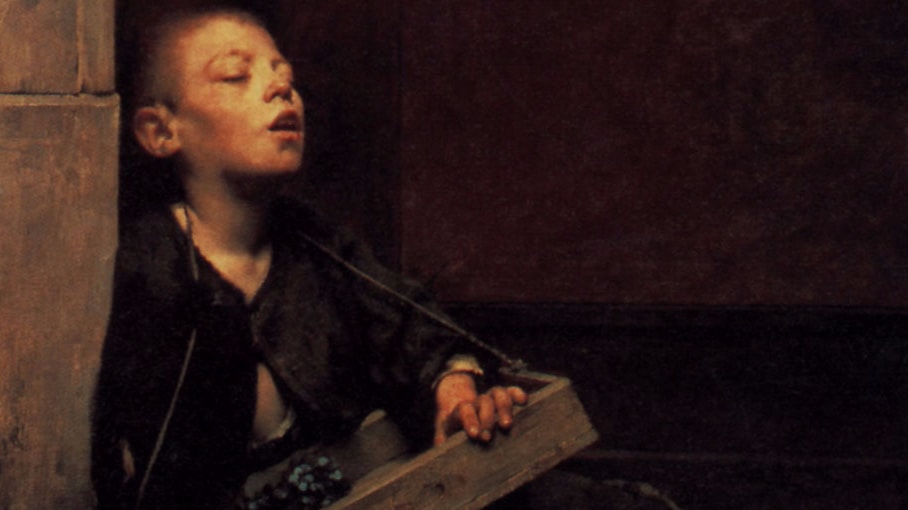
Fred Ross, ARC's Founder and Chairman's, Keynote Address, drove the debate surrounding the Hard Times Exhibit at the Salmagundi Club in New York City on July 29th, 2010. This speech, exposed some of the breakthroughs from his research which will be fully laid out in his introduction to the upcoming William Bouguereau Catalog Raissoné which he worked on for 32 years with Damien Bartoli and Mark Walker and which is predicted to completely shake up the art world as the main historical underpinnings behind Modernism are exposed as a fraud.
It's a pleasure to address you all here this evening.
Today, at the Salmagundi Club, we are surrounded by powerful works of art that focus on a theme of current relevance and inspires in us compassion and empathy...during "Hard Times." For some, we already live in hard times, and for all of us, there is a feeling of insecurity as we deal with economic crises and an uncertain future. The artists here, have taken up this important theme, because they want to communicate their distress and concern by observing those less fortunate. They have a natural need or drive to express social awareness in their own personal styles.
Their intent is to make us aware and instill in us compassion and maybe the desire to do something to be helpful. What many people may not realize, is that the freedom to take on this theme, and countless other themes about humanity derives from the 19th century, a time when new found freedoms of expression flourished as a result of 18th Century Enlightenment breakthroughs and the Political and social revolutions they inspired.
Artists and writers alike took up the same causes, some of which were writing and painting about the less fortunate. It is not from the halls of Modernism and avant-garde movements such as Abstract Expressionism that themes such as Hard Times would find its roots. In fact, the Modernist movement rejects such themes and calls them sentimental, passé and imbued with contrivances such as realistic images and storytelling painting. The modernist paradigm has no patience for the less fortunate...only for his or her own narcissistic often nihilistic self-expression.
So we must turn to the 19th century, as serious artists, art historians and art lovers, to find again the roots of such fine art themes touching upon the universal human condition and touching the souls of its audience.
During the late 19th Century and early 20th century, the writers who exposed injustices in society and the plight of the poor, the sick or the downtrodden, were generally praised for the important job they did in helping to improve society. Some of them like Charles Dickens, Mark Twain, Victor Hugo , Honore de Balzac, Upton Sinclair and John Steinbeck, are still elevated to the heavens for their greatness. Yet visual artists who were painting the same subjects about which the writers were writing were dismissed, denigrated and ridiculed. They successfully showed the hard lives of the poor and disenfranchised as do the artists in this exhibition, but even though they received great acclaim in their own day, and even from the great writers of their time, yet in the 20th century their reputations became victims of a Modernist Leviathan whose agenda to elevate Modern art needed to denigrate traditional realism to survive comparison.
Art history as it has been written by the Modernist and Post-Modernist art establishment, has been distorted in order to support that paradigm.
If you took any course in art History during the past 65 years, at any college or university in the western world, whether undergraduate or post-graduate, you were taught that before the Impressionists and post-Impressionists upon whom is lavished the most extreme praise,...before them the art world was controlled by a gaggle of petty academic artists who painted inane, silly or overly sentimentalized maudlin works who cared only for perfection of technique. And that was it. No analysis beyond that, no mention of all the movements and styles and innovations and frankly brilliant achievements that were occurring at the same time.
If you were, on the other hand, a student of general History, meaning social, societal and political history as studied by history majors, and then you decide to take one of these Art History courses, you will quickly notice a gaping abyss that exists between Art History and History in general. The two are surprisingly disconnected where the one would seem to have nothing to do with the other as if it had occurred in some parallel universe. Art history texts mostly ignore historical context when reporting the art history of the 19th Century. They report what was going on from the sole perspective of modernism whose only interest is finding events that they can report as having lead the way to Abstraction in Art as it occurred after World War II.
Nowhere is there any discussion with how this all relates to what was going on in the real world. The closest they come is to mention the fact that the French State backed the Paris Salons and then had the mendacity to say that in 1873 Manet lead the Impressionists to open the Salon de Refusé and that the Paris Salons were controlled by those evil academics who kept rejecting their works.
In my introduction to the William Bouguereau Biography and Catalog Raissoné (which is finally at the printer) ...
In my introduction, I start to redress this misinformation,...and it is misinformation.
This whole story about the Impressionists being held back by the academic artists and not being shown in the Paris Salon never actually happened. Manet did not lead them and did not open the Salon de Refusé.
There is no proof anywhere that Matisse was kicked out of Bouguereau's atelier with the comment that he didn't know how to hold a pencil. The only origin we can find to this whole sordid story is this: Apparently Emile Zola, a zealot for Impressionism wrote a novel called The Masterpiece, a fictional account of what transpired, making up all these facts...only he didn't claim they were facts. It was just a story he told.
We now know that Manet and the Impressionists, in fact, had nothing to do with the Salon de Refusé which was not originated in 1873 as they reported. In fact, it is 1849 which is the most pivotal year in art history which makes a lot of sense considering that 1848 is the most pivotal year in political, cultural, and societal history when there were revolutions throughout Europe modeled to varying degrees on the earlier revolutions in America and France. Before 1849 only a few hundred works were shown in the Paris Salons, most of the thousands of works entered were flatly rejected, and those who had won awards in the past or who had positions of authority were given greater benefits, allowed to have more of their works exhibited each year, and could dole out benefits to their friends, and even got to say whose works got to hang in the best places.
But in 1848 all that changed. And in 1849 the rules were greatly liberalized and from that year forward nearly half of the entrées were given space to hang. When those changes occurred Renoir was 8, Monet was 9, Degas was 15, as was Whistler , Manet and Pissarro were 18, Cézanne was 10.
So by 1863 over 2,200 works were accepted in the Paris Salon out of 5,000 entered. How narrow and exclusive does that sound? But surely Impressionist paintings were rejected...weren't they? Actually...NO. They were not rejected. There was hardly anything at all that could be called Impressionist in 1863.
Why 1863? Because that is the year when the Salon de Refusés was originated which was actually the brainstorm of no other than...Napoleon III who felt sorry for a complaining group of academic artists who had been rejected, so he ordered a nearby building be sequestered and prepared for this purpose. Over 700 works were shown there but it was such an embarrassment that by 1864 only 231 works were exhibited and it was promptly abandoned after 1864. Manet and the Impressionists had nothing to do with it.
I don't have time now to show all the other things that are taught that did not occur, but there is massive evidence that the actual path of art history indeed follows political and cultural history much the way one might expect if the data was approached without Modernist goggles that filter out 99% of the facts.
And it is through the prism of history that we find the origins of the subjects and themes of the paintings during the 19th century which relate to today's Social Realist themes of "Hard Times" which was amongst the most important of the endless number of new subjects that artists and writers tackled with society's new found freedoms.
Between 1850 and 1900 there are countless works that focused on the poor, the sick, the old, the crippled and the downtrodden in any number of ways. For the many centuries prior to the 19th century with few exceptions fine art, using the methods and techniques of realism, confined itself to religious themes, great historical events and to portraits of Kings, queens, clerics and the aristocracy.
It wasn't until the Enlightenment — and all those revolutions in Europe and America, that artists expanded geometrically the scope and depth of their subject matter. Enlightenment thinkers like John Locke, Thomas Hobbes, and Alexis De Tocqueville, spelled out what it meant to be a free people and what it meant to be slaves. And the revolutions that ensued lead to governments legitimized by the consent of the governed through democratic elections and an emphasis on Human rights as enshrined in our nation's Bill of rights spelling out the protection of the people from the government and the protection of the minority from a tyranny of the majority. Property rights were yet a third cornerstone so that people could keep the fruits of their labor with security that it would not be stolen from them by thieves or by the government itself.
The artists like the writers of the 19th century codified these developments through their artwork, and just as "The People" became the sanctified individual units of power, the artists drawings, pigments and brushes were put to the task of humanity...to do the people's business instead of the church or the monarch.
Amongst the most favored of themes about the human condition were about the plight of the poor, the homeless, the sick the helpless, and the hopeless, child labor, unwelcome and unwanted gypsies and peasants hard at work, preparing for work, resting after work, or placing them in scenes of everyday life which often as not demonstrated how much alike their lives and humanity were with those of the viewers.
The Western world moved from a world filled with edicts of the "Sovereign" to a world ruled by "Sovereign States." Terms like the "general will" and "social contract" and "government, of, by and for the people" were repeated everywhere.
Justice, equality under the law, elections by popular vote; protection of human rights were the obligation of government and society to identify, organize, and protect those rights. Freedom of speech and of the press [and make no mistake about this, Fine Arts were a critically important part of freedom of speech and the press. More so, in the 19th century when photography was in its infancy, and there were no movies, no TV nor any of the relentless barrage of visual imagery that we all enjoy or endure today the only visual images of quality that people could use to express feelings or communicate ideas, beliefs and values were with the fine arts of painting and sculpture.
So it was the writers and artists of the "first" century of liberty and freedom, ... the 19th Century,... that were given the duty and responsibility to organize, to codify, to popularize and protect the systems, laws, and democratized institutions of society which would insure the perpetuation of liberty...a way of life so recently come to the affairs of man. How they were to discharge these duties would surely impact and effect future generations perhaps for centuries to come.
And it was the writers and artists whose words and images were disseminated everywhere throughout the newly "Free" world. They worked together permitting and insuring popular disclosure of the plight of the less fortunate including wives, whose husbands controlled their wealth and their children. They showed the world the poor, the homeless the sick, the crippled, gypsies the downtrodden and the enslaved. Others showed the hypocrisy of clerics who preached giving up worldly goods while living in the lap of luxury. The writers and artists forced society to view reality and then to question deliberate, debate and to then find answers and resolutions for countless injustices from, or embedded in, remaining and recalcitrant institutions which were still riddled with the followers of former rules and rulers who fought to hold on to their power.
For example in his Discourse on the Origin of Inequality, Jean Jacques Rousseau ended this great historical essay speaking about current day injustices in France, "since it is plainly contrary to the laws of nature...that the privileged few should gorge themselves with superfluities; while the starving multitude are in want of the bare necessities of life." He lashed out at an indifferent society and observed "... how poverty could deprave and degrade men and women who were originally good".
So the intensely Humanist art of the back half of the 19th Century had only really just begun when it started to be suppressed by Modernist elitist concepts. The academic artists were seeking and telling the truth about the human condition. But after only 50 years it was already being supplanted which means that very little of the knowledge of the world which came after that period has been addressed by traditional realism. And they say about realism "That it's all been done" How is that possible in only 50 years?
Just think about what occurred in the next 50 years and then the next after that. The number of potential themes and compositions for artists are every bit as broad and boundless as they are and have been for writers, musicians and cinematography.
I've heard said, "Why would people want to purchase scenes of poverty and 'hard times' to hang on their walls?"
Because the artist that succeeds demonstrates the beauty of humanity, and the value of charity and importance of protecting human life preached from every pulpit in every cathedral, church, temple, and synagogue for hundreds of years. "here but for fortune go you or I"
Brotherly love, caring for the poor and unfortunate, charity in every form became the backbone of advanced civilization, society and culture. The image of our way of life and belief in the superiority of our form of government, and self image as a people has become inextricably attached to how we treat the poor and less fortunate. No longer are they thrown into work houses, orphanages, crazy houses or debtors prisons. Throughout the Victorian and 19th century worlds we saw developing laws, organized charities and institutions to help people. At its best They helped people to help themselves.
So today artists...the artists in this exhibition have picked up where the 19th century beginnings, were forced to drop this new subject matter after only a half century of ascendancy (compared to hundreds or thousands of years for religion and, kings and history painting). For these works embody our humanity as they portray the humanity in their subjects, and the values of empathy and charity are by such works taught to society and our children.
No wonder Realism is coming back. Rejecting art about such subjects is to reject the very character of what it means to be an American, what it means to be a Christian, a Jew or a member of most religions. Rejecting such subject matter in art is tantamount to rejecting what it means to be human, since the ability to care about and care for others is what sets us apart from any other species on earth.
Modernism's ridicule of representational and straight-forward paintings of children, or old people or people in want or suffering from disease, hunger or mental disorders, is really no different than dismissing the very people who inspired such works. If a painting of poor beggar girls is denounced for its sentimentality, then such critics are really saying we should not care about the poor, the vulnerable or the innocent as they are not even fit to be subjects in a painting.
The denigrating of sentiment has been a cornerstone of the Modernist paradigm, whereas sympathizing and finding ways to help poor and suffering people has for centuries been the backbone of Judeo-Christian culture.
Modernism has been rejecting the very things that make us proud of who we are and deserving of the prosperity we enjoy. Hard times as they are portrayed by the classical and traditional realists of this exhibition are once again doing their societal job of teaching values of honesty, integrity, and respect.
But to be great works of art they still need to be composed with innovative and engaging power, and drawn, modeled and painted with poetry and grace. But the choice of great subjects is the first step to great painting for no matter how great composition and technique are they can only go so far if they are not first in the service of a great subject. The artists of Hard Times are doing their part to reinstall positive values and ideals in the visual arts; which make us worthy as a people to live in a society that teaches empathy, kindness and charity to successive generations.
